

7 Ways Buy-Side Firms Structure Expert-Network Call Notes for AI Retrieval
Seven note-taking structures analysts use during expert calls, and what each one costs or saves once the output hits a retrieval agent.

Transcripts have quietly become the ingestion layer for buy-side research agents. That has changed what a good expert-call note looks like: it is no longer a private artifact the analyst reads twice and forgets, it is a document a retrieval system will parse, chunk, embed, and surface to a colleague or an agent six months from now. The seven structures below are the note-taking patterns buy-side analysts use during expert-network calls, each with a specific mechanic and a specific downstream consequence for AI retrieval. Vendors are named as factual examples of a category, not as ranked picks.
1. Verbatim Transcript With Margin Notes
The simplest and, increasingly, the dominant pattern. The vendor-produced transcript is the primary record, and the analyst adds a thin annotation layer during or after the call: a timestamped comment, a colored highlight, a one-line summary at the top. Firms working with AlphaSense and Tegus, Guidepoint's transcript library, or Third Bridge Forum treat the transcript as the canonical object and the analyst layer as metadata.
The reason this pattern is winning is retrieval. When Guidepoint exposed transcript access to Perplexity and Claude via an MCP connector, the assumption baked into the design was that the transcript is what an agent will search, not the analyst's paraphrase. Paraphrase is lossy; the transcript preserves the expert's exact hedges, numbers, and qualifiers, which is what a downstream synthesis step needs to weight a claim.
The trade-off: margin notes are unstructured. They help the original analyst months later but do not always survive into a firm-wide vector store in a useful shape. Funds that use this pattern usually pair it with one of the more structured patterns below when a call feeds a live thesis.
2. Thesis-Tagged Notes
The analyst declares an investment thesis before the call and tags each answer during the call against a fixed schema: bull point, bear point, disconfirming evidence, neutral color. The tags are inline (a bracketed prefix, a column, a structured field in the note-taking tool) and survive into whatever store the notes land in.
The payoff is on the retrieval side. Once tagged notes from twelve calls sit in a corpus, an analyst or an agent can ask a genuinely useful question: retrieve every disconfirmation of the thesis on datacenter GPU pricing across the last quarter of expert conversations. Without the tags, the same query returns a wall of loosely relevant passages and the analyst is back to reading transcripts.
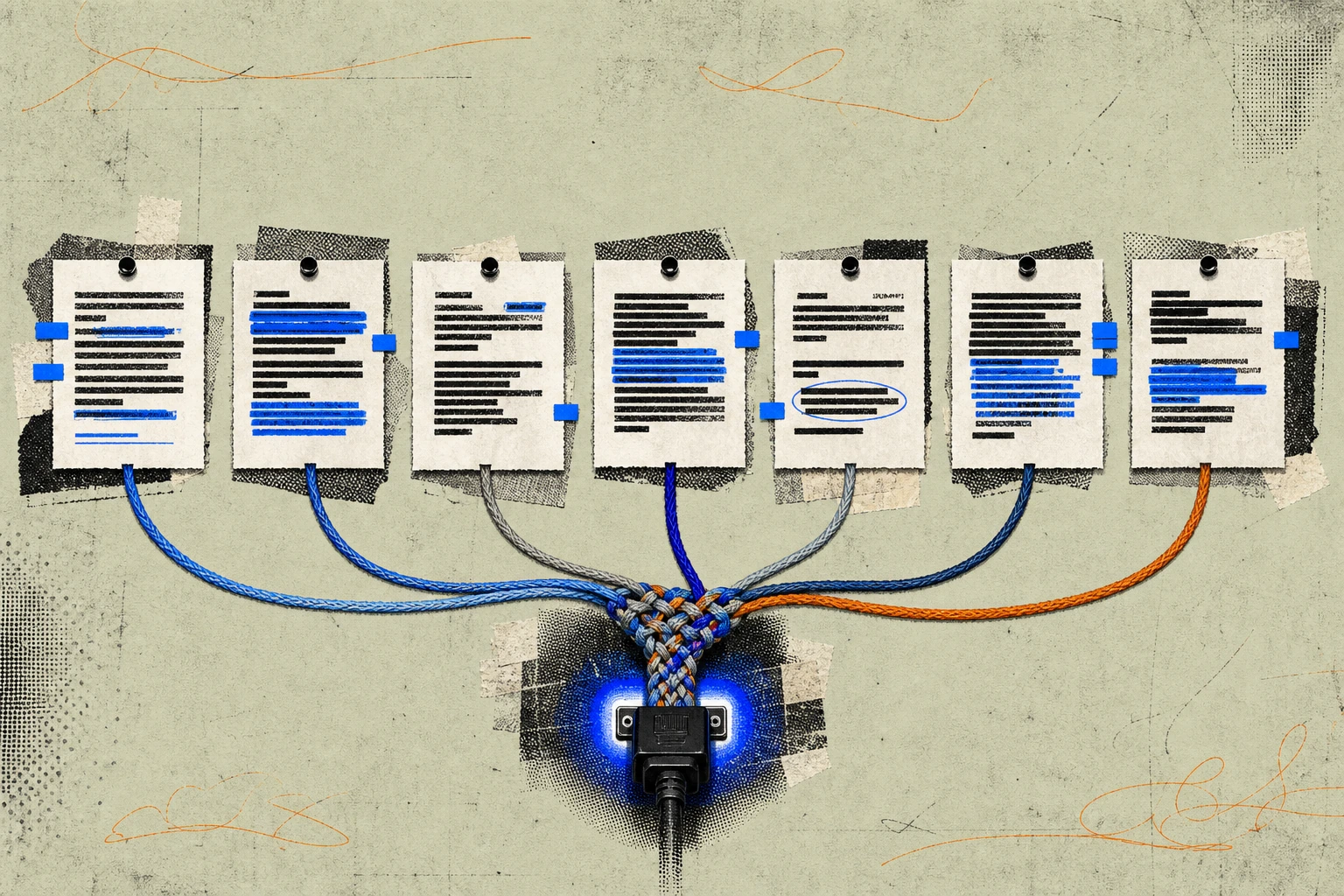
Thesis tagging is heavier during the call, which is its main cost. It also depends on the analyst having a real thesis before dialing in, which is more common on the buy side than on the sell side but is not universal.
3. Structured Q&A Template Against a Research Plan
Common in private-equity commercial due diligence, where a research plan is submitted to the expert network before the call and questions are numbered. Firms sourcing via Dialectica, Third Bridge Connections, and Inex One tend to arrive with a pre-agreed question list; the numbering is the structure.
The mechanic is simple: Q1, Q2, Q3 in the plan map to Q1, Q2, Q3 in the notes, and each answer sits under its numbered question. The numbering survives into vector storage as document structure, which measurably improves recall for later queries scoped to a specific diligence workstream (e.g., pricing power, customer concentration, competitive displacement). An agent asked to synthesize the pricing-power view across nine expert calls in a diligence sprint can retrieve cleanly when every call has a Q4 answer on that topic.
The limitation is rigidity. Structured Q&A works when the research question is well-defined; it works less well for exploratory calls where the analyst does not yet know what they are looking for.
4. Entity-First Notes
Here the analyst captures named entities inline as first-class citizens: competitors, customers, SKUs, geographies, dollar figures, dates. The note style tends toward a compressed shorthand where entity mentions are consistent and canonical (Nvidia H100, not "the flagship chip") so that downstream entity-tagging pipelines can resolve them to canonical IDs.
This pattern matters because entity resolution is one of the first steps in the ingestion pipelines that vendors like AlphaSense and Tegus run at scale. If the raw notes already contain clean entity mentions, the automated tagging step produces a cleaner index, and cross-call queries ("every mention of TSMC N3 capacity across our expert calls this quarter") return the right passages instead of a fuzzy set.
The cost is cognitive load during the call. Analysts have to be disciplined about naming, and expert speech is often deliberately vague on entities for compliance reasons, so the note-taker is doing real work to canonicalize on the fly.
5. Confidence-Scored Notes
Each claim in the notes is marked as first-hand (the expert saw or did this themselves), second-hand (heard from a named or unnamed source), or speculation (the expert's inference or opinion). The scoring is inline, usually a single-letter prefix, and it travels with the claim into whatever store the notes populate.
The reason this is climbing the priority list is that research agents increasingly weight source-confidence in synthesis. Rogo, Hebbia, and Bridgetown build products where the agent's output is only as defensible as the confidence signal on the inputs. A synthesis that treats an expert's speculation about a competitor's roadmap the same as their first-hand account of their own former employer's pricing is a synthesis an analyst cannot take to an investment committee. Confidence tags in the notes let the downstream layer weight, or filter, accordingly.
This is also a compliance-adjacent structure. First-hand claims are the ones most likely to need MNPI scrutiny, which leads directly to the next item.
6. MNPI-Flagged Notes
Analysts flag potential material non-public information in real time, usually with a distinctive marker that a compliance workflow can find (a specific tag, a specific color, a designated field). The flag is not a judgment that the passage is MNPI; it is a signal that compliance should look before the note enters the firm's research corpus or any store exposed to an internal MCP endpoint or agent.
The structural point is that redaction has to happen before ingestion, not after. Once a passage is embedded in a vector store and surfaced to a colleague's agent, retroactive removal is hard and audit-fragile. Expert networks are building redaction layers on their side; buy-side note-taking is building the mirror-image capture discipline on the client side, so the two layers meet at the compliance review before anything goes into a retrieval index.
This is the structure with the sharpest downstream cost of getting it wrong, and it is the one most likely to be enforced by policy at funds with a serious compliance function.
7. Follow-Up-Linked Notes
Every unresolved question in the call generates a structured stub: a short record that names the open question, the entity it concerns, and (optionally) the profile of the expert who could answer it. The stub routes back into the expert-network sourcing queue, so the next engagement is scoped by what the last one did not resolve.
This closes a loop that has historically been open. Without follow-up stubs, unresolved questions live in the analyst's head and get lost against the next week's calendar. With them, the call output feeds the next sourcing brief automatically, and over a quarter the fund's expert engagements start to compound rather than drift. On the retrieval side, the stubs themselves become a useful corpus: an agent can retrieve every open question tagged to a name or a thesis and produce a live gap analysis.
The requirement is tooling. Follow-up-linked notes work when the note-taking tool talks to the sourcing tool, either through a shared workspace or through an API. Manual copy-paste from a Word document into a sourcing form is where the discipline dies.
Are your experts using AI to cheat?
Try our free demo to find out today.
Powering institutional-grade transcription for expert networks.
INFLXD provides AI-powered, human-edited transcription with sub-1% error rates for the world's leading expert networks and financial research firms.
Visit inflxd.com →Keep reading.

How Buy-Side Firms Handle Expert-Network Pre-Call Materials: 7 Structural Models
Pre-call attachments sit outside the recorded-call boundary, and buy-side compliance teams have built seven distinct ways to handle them.

Bridgewater CIO Greg Jensen says AI is already doing the equity analyst job
On Bloomberg's Odd Lots, Jensen said machine-side outputs at the fund now stand next to a 50-year human research process.

OpenAI launches ChatGPT for Financial Services, targeting Wall Street research workflows
The vertical release bundles data connectors, cited research, and deck generation, and lands on FactSet and S&P Global's turf.