

The earnings-call transcript stack: how primary-source audio is becoming an AI-grade dataset
Earnings transcripts are being re-engineered from reading material into a machine-consumable dataset layer, and the vendors who control timestamped, speaker-labeled, audio-anchored versions are becoming infrastructure for the buy-side AI stack.

Earnings-call transcripts have sat on the buy-side desk for two decades as a reading artifact: a PDF, a web view, a copy-paste source for a memo. That model is breaking. The transcript is becoming a dataset, queried by an agent, cited back to source audio, and routed through a tool call rather than a browser tab. The vendors who control the structured, audio-anchored, speaker-labeled version of that dataset are positioning to be infrastructure for the next layer of buy-side AI, not a content product underneath it.
The shift is visible across four moves in 2026. Aiera launched a sell-side-validated content platform with MCP access that routes transcripts, filings, and broker research into AI tool calls. Quartr has pushed real-time transcript delivery with timestamped audio anchors and now distributes through API to AI-native research clients. Daloopa closed a USD 47M Series C and shipped MCP integrations with Rogo and other agentic-research platforms, publishing a benchmark that showed a 71-point accuracy gap when LLMs were grounded on structured primary data versus unstructured retrieval. AlphaSense crossed USD 500M in ARR with a transcript-and-filings corpus at its core. Anthropic's Model Context Protocol roster now includes Moody's and expert-network libraries alongside these earnings sources.
The pattern is consistent enough to call: primary-source audio is being converted into a machine-grade dataset with provenance back to the original recording, and that conversion is the binding layer for finance-vertical LLMs.
From reading material to tool-call surface
The consumption model for a transcript used to assume a human reader. The product had to be readable: clean typography, a sensible scroll, a search box that returned a highlighted snippet. The reader did the work of judging whether the snippet answered the question and whether the speaker's title made the quote weight-bearing for a memo. That was the entire job of the interface.
The consumption model now assumes an agent. The agent does not scroll. It calls a tool, asks for the segment of the Q&A where a named analyst pressed the CFO on gross margin guidance, expects a structured response with the speaker role, the timestamp, the audio anchor, and the source identifier, and writes the citation into the analyst's draft note. The interface the human sees is downstream: a generated paragraph, a footnote, a click-through to the original audio. The product surface that matters is the tool call.
This is not a rebrand. It is a different product. A transcript designed for a human reader can be approximately right about who said what; a half-second error in a speaker boundary is invisible to a reader and fatal to an agent that is going to attribute a quote to the wrong executive. A transcript designed for an agent has to be wrong rarely enough that the citation downstream is audit-defensible. The QA bar moves from readable to citable.
Aiera's June launch is the cleanest expression of the move. The platform's framing is sell-side-validated content delivered through MCP, which is a statement about who the consumer is. Sell-side validation is not for the human equity analyst; it is the provenance stamp the agent needs to justify using the source in a generated answer. The platform is positioning itself as a tool, not a reader's product.
What dataset-grade actually means
The engineering requirements for an agent-grade transcript are specific and unforgiving. They map onto what MCP-era agents need to cite a quote with audit-grade sourcing, which is the bar the buy-side will eventually require before any LLM-generated number gets near an investment committee.
The minimum set looks like this:
- Speaker diarisation that is consistent and corrected. Not best-effort. Every utterance has to be attached to a named speaker with a role and a firm, with errors low enough that an automated downstream pipeline can rely on the label. "Unidentified speaker" is a dataset failure, not a transcript footnote.
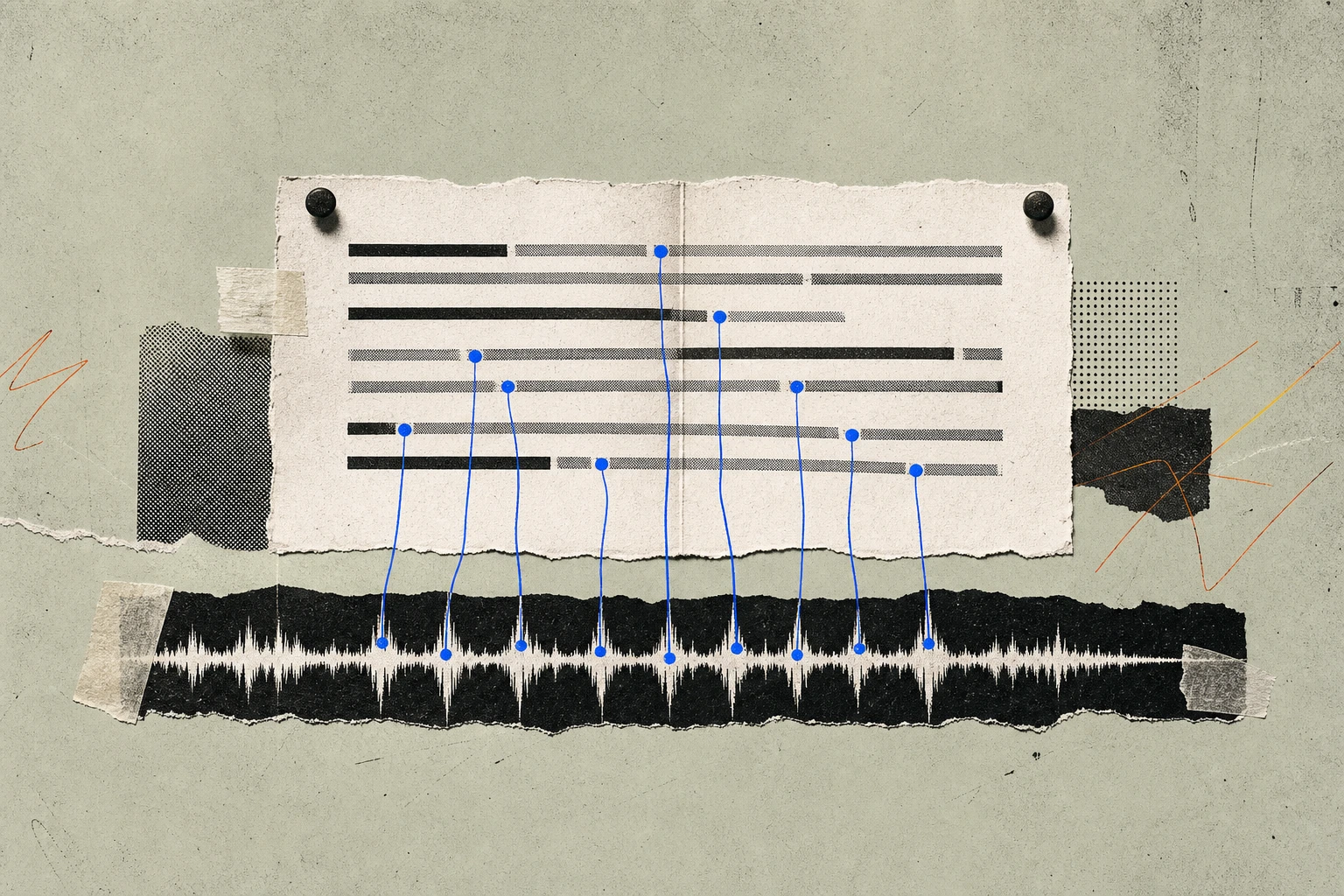
- Timestamp-to-audio anchoring at sub-sentence granularity. Every quoted segment has to point back to the offset in the source audio where it begins and ends. This is what makes the citation auditable: the reviewer clicks the timestamp and hears the words.
- Segment-level metadata for prepared remarks versus Q&A. These are different evidence classes. Prepared remarks are scripted disclosure; Q&A is improvised under analyst pressure. A model that cannot tell them apart will mix carefully lawyered language with off-the-cuff color and treat them as equal-weight evidence.
- Management-versus-analyst tagging on every Q&A turn. The same question and answer pair contains a sell-side analyst's framing and a management response. Agents need to know which side of the exchange a quoted line came from.
- Provenance back to the source recording. Not a link to a transcript page. A link to the audio file, with a timestamp, ideally with a checksum or other identifier that survives reprocessing.
- Stable identifiers across reprocessings. When a transcript is corrected after the fact, the segment identifiers cannot change underneath downstream citations, or every memo that cited the old version silently breaks.
None of this is editorial work. It is data engineering, with an audio-processing layer underneath, and a QA discipline on top. The vendors who do it well are converging on the same shape regardless of which corner of the market they started in. Quartr came from the real-time transcript delivery angle. Aiera came from the sell-side content angle. Daloopa came from the structured financial data angle. The dataset shape they are landing on is broadly the same, because the consumer downstream is the same: an agent that needs to cite.
The 71-point accuracy gap
Daloopa's published benchmark is the single most useful data point in this discussion. The headline finding, a 71-point accuracy gap when LLMs are grounded on structured primary data versus unstructured retrieval, is not a marketing number once the implication is followed through.
The implication is that the model's ceiling on finance-vertical questions is set by the quality of the data layer underneath it, not by the model itself. Two LLMs of the same generation, querying the same universe of earnings calls, will produce wildly different accuracy depending on whether the underlying retrieval surface is a clean structured corpus with provenance or a pile of PDFs and HTML pages that have to be parsed at query time.
This reframes the competitive question for the buy-side AI stack. The temptation through 2024 and 2025 was to treat the LLM as the product and the data layer as a commodity, with each research agent picking up whatever transcripts and filings it could scrape or license. The benchmark suggests the opposite: the LLM is closer to a commodity, and the structured primary-source layer is the differentiator. A research agent that grounds on a clean dataset will outperform one that grounds on noise, regardless of which foundation model sits on top.
Our read is that this dynamic is what is pulling MCP integrations to the front of the roadmap at every serious primary-source vendor in finance. MCP is the protocol that lets the data layer present itself to the agent on the agent's terms. A vendor without an MCP surface is, in this market, betting that humans will keep doing the integration work between the data and the model. That bet is getting harder to defend.
Why the MCP roster matters
Anthropic's MCP roster is a useful tell for which data layers are being treated as infrastructure. The roster now spans Moody's on the credit side, expert-network libraries on the qualitative-primary-source side, and the earnings-and-filings vendors on the quantitative-primary-source side. The list reads as a map of the categories that buy-side agents need to cite from to do their job.
The convergence is striking. The provenance schema that earnings-transcript vendors are adopting, speaker-labeled, timestamped, anchored to source audio, segment-tagged, is the same schema expert-network transcript libraries have been building toward for years for compliance reasons. The driver was different. Expert networks needed audit-grade transcripts because MNPI compliance demanded the ability to review what an expert had actually said. Earnings-call vendors are arriving at the same shape because agentic citation demands the ability to point back to source audio. Different first principles, same dataset.
This is the part of the story we find most useful to flag for INFLXD's audience. The provenance bar that expert networks built for compliance turns out to be the provenance bar that AI-native research demands for citation. The two layers are converging on a shared schema, which means the engineering investment a compliance-driven vendor made five years ago is suddenly load-bearing for a use case that did not exist when the investment was made.
Three scenarios for the data layer
The shape of the next 18 months depends on which of three scenarios resolves.
Scenario one, the dataset layer wins and consolidates. The vendors who own structured, audio-anchored, MCP-addressable transcript corpora become the default citation surface for buy-side research agents. AlphaSense, Aiera, Quartr, Daloopa, and a small number of expert-network libraries form the layer the agents query. New entrants on the LLM side, including the agentic-research startups, route their tool calls into this layer rather than scraping or licensing raw text and parsing it themselves. The economics shift toward the data layer.
Scenario two, the foundation-model labs build in-house. OpenAI, Anthropic, and Google decide that the structured primary-source layer is too strategically valuable to outsource and build or acquire their own. The benchmark gap Daloopa published becomes an internal product roadmap. Independent data vendors get squeezed into a wholesale relationship with the labs and lose direct contact with the buy-side. This is the scenario most threatening to the current independent vendors and most useful to model the downside under.
Scenario three, fragmentation by primary-source class. Earnings transcripts consolidate around two or three vendors, expert-network libraries consolidate around the established expert networks, credit and ratings consolidate around the established credit data vendors, and each of these categories presents itself through MCP without a meta-layer emerging. The agent picks which surface to query based on the question, and the friction of integrating across them is borne by the agent builder.
We read the current evidence as pointing toward a hybrid of scenario one and scenario three: dataset-layer consolidation within each primary-source class, with MCP as the lingua franca across classes. The foundation-model labs have shown an appetite for owning protocols, like MCP itself, more than for owning content. Aiera's sell-side-validation framing and Quartr's API distribution into AI-native clients both look like positioning for that world.
What this implies for adjacent layers
The second-order effects of this shift are worth flagging because they extend beyond the earnings-transcript category.
Expert-network transcript libraries sit in the same dataset-grade shape and are already being routed through MCP. The compliance-driven provenance work that the established expert networks did over the last decade is now an AI-stack asset, not a back-office cost. The vendors who skipped that work are exposed.
The sell-side research layer faces a similar pull. Broker research that is delivered as a PDF to a human reader is a different product from broker research delivered as structured citations to a tool call. Aiera's sell-side-validated framing suggests that the broker research category will face the same dataset-grade restructuring earnings transcripts have already started.
Alternative-data vendors that have historically sold to quant desks have to decide whether their data is shaped for human analyst consumption or for agent consumption. The two product shapes diverge, and trying to be both at once is expensive.
The internal research-ops function at large funds also changes shape. The team that managed the transcript subscriptions, the broker research feeds, the expert-call libraries, and the alt-data licenses becomes the team that manages the MCP surfaces, the citation provenance, and the audit trail from a generated note back to source audio. The skill set is closer to data engineering than to vendor management.
What we would ask next
If an INFLXD reader were preparing to put questions to an expert in this space, the questions worth asking are specific and answerable:
- How does the cost of producing an agent-grade transcript, with speaker diarisation, audio anchoring, and segment metadata, compare to the cost of producing a reader-grade transcript at the same vendor, and how is that cost trending?
- What is the realistic error rate on speaker diarisation at the top three vendors today, and what is the downstream attribution error rate when an agent cites a quote based on that diarisation?
- How are buy-side firms handling versioning when a transcript is corrected after the fact and previously generated citations point at an outdated segment identifier?
- Which of the agentic-research platforms have moved from prototype MCP integrations to production usage with billed query volume, and where is that volume concentrated by vendor?
- How are the foundation-model labs pricing tool-call access to these data layers, and is the economics shifting toward the data vendor or toward the lab?
Powering institutional-grade transcription for expert networks.
INFLXD provides AI-powered, human-edited transcription with sub-1% error rates for the world's leading expert networks and financial research firms.
Visit inflxd.com →Keep reading.

Magnetar prepares AI-agent equity fund for 2026 launch
The $18 billion firm is building a long-biased equity strategy where hundreds of AI agents handle research work normally done by analyst teams.
Accenture Ventures takes stake in AlphaSense, sets agentic workflow partnership
The consulting firm's venture arm backs the market intelligence platform as the two move to embed AlphaSense data inside enterprise AI agents.
AlphaSense raises $350M at $7.5B valuation, crosses $600M ARR
The market intelligence platform extends its content moat and AI roadmap with fresh capital from J.P. Morgan Private Capital and Viking Global Investors.