

Inside the Hebbia-Centerview deployment: how an advisory firm operationalized agentic research across its bankers
What it actually takes to put an agentic research platform in front of a banker base, traced through the Centerview Partners rollout.

Centerview Partners' firmwide deployment of Hebbia is one of the few publicly named, fully-bankered rollouts of an agentic research platform at a bulge-bracket-adjacent advisory firm. It is worth studying not because the technology is novel in the abstract, but because the integration pattern, long-context reasoning plus document connectors plus a citation-grounded review surface, is becoming the template for how advisory and buy-side firms put generative AI next to primary research.
The case also clarifies what an enterprise deployment of an agentic research tool actually requires once the demo is over.
Background: the advisory firm's research problem in 2024
By 2024, advisory and buy-side firms were under sustained pressure to put generative AI next to primary research workflows. Leadership at firms including Centerview Partners had said publicly that senior bankers were spending too much of their time on document review and synthesis rather than on client judgment, the part of the work that justifies advisory fees.
The research workload at an advisory firm has a specific shape. A coverage banker preparing a pitch or working a live deal is moving between filings, transcripts, broker research, expert call notes, internal precedent memos, and, on a live mandate, a data room that can run to thousands of documents. The synthesis step, reading the documents, extracting the relevant facts, cross-referencing them, and writing the page, is where junior bankers spend their nights and where senior bankers lose their leverage.
This is the workflow that an agentic research platform has to slot into. Not a chatbot bolted onto the side of the desk. A tool that sits inside the document review step itself.
The approach: what Hebbia's Matrix actually does
Hebbia, founded by George Sivulka, built its Matrix product around a specific architectural bet. Rather than treat a research question as a single prompt against a retrieval-augmented model, Matrix decomposes the question into parallelized sub-queries that run across long-context documents, and returns the answers in a spreadsheet-like grid where each cell carries a citation back to the source.
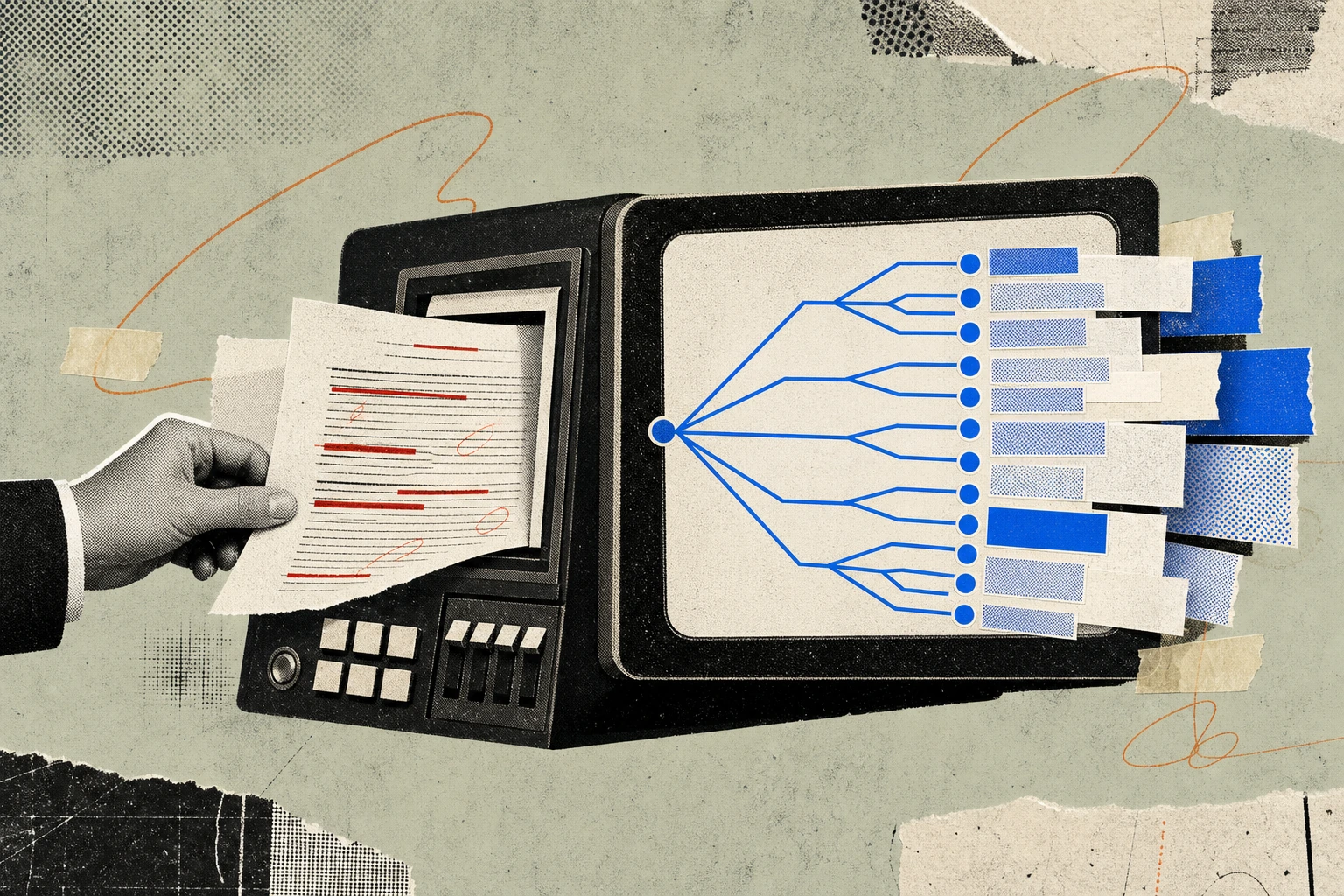
A banker asking, for these twelve target companies, what did management say about pricing on the last four earnings calls, and how does that compare to the segment disclosures in the 10-K, gets a populated matrix with linked citations into the underlying transcripts and filings. The grid is the interface; the citations are the review layer.
Three properties of that design matter for an advisory deployment:
- Long-context handling. Filings run past a hundred pages. A live data room can hold thousands of documents. Matrix is built to read at that scale rather than truncate.
- Parallel decomposition. A pitch question is rarely one question. It is fifteen questions across twelve targets. The grid format makes the decomposition explicit and the answers comparable.
- Citation grounding. Every cell links back to the source. A banker reviewing the output sees where each fact came from, which is the only structure under which the output is usable in a client deliverable.
That third property is the one that matters most for the advisory use case. A research output that cannot be traced back to its source cannot be put in front of a client. The citation layer is what makes the tool defensible up the chain to a managing director and, ultimately, into a board pitch.
Funding and the enterprise balance sheet
Advisory deployments are not a self-serve motion. They require a security review, a procurement process, an integration with internal document repositories, and a sustained customer-success relationship through the rollout. That work needs a balance sheet behind it.
In July 2024, Hebbia announced a USD 130M Series B led by Andreessen Horowitz, with Index Ventures, Google Ventures, and Peter Thiel participating. Bloomberg reported the round valued the company at roughly USD 700M. The round was sized to fund enterprise deployments at named financial-services customers rather than a horizontal land-grab.
In the same disclosures and the press coverage around them, Hebbia named Centerview Partners as a deployed customer, alongside the U.S. Treasury, Charlesbank, and large asset managers. The Centerview reference is the one that carries the most weight for the advisory category: a firm whose entire business model is senior banker judgment putting a generative AI tool in front of its banker base is a stronger signal than a horizontal enterprise logo.
What the integration actually required
The public disclosures do not break out Centerview's internal usage metrics, and they should not be reverse-engineered. What is visible in the public record is the shape of the integration work, and it lines up with what an advisory deployment of this kind has to involve.
Three integration surfaces matter:
Internal document repositories
An advisory firm's institutional memory lives in its internal document store: prior pitches, precedent transactions, internal research memos, KYC files, and the working papers from live deals. Hebbia's value at an advisory firm depends on Matrix being able to read that corpus under the firm's access controls. This is the connector work that does not show up in a demo and that determines whether the tool is used.
External primary sources
Filings, transcripts, and broker research are the other half of the corpus. The platform has to reach them under the firm's existing entitlements rather than asking the banker to paste documents into a window.
Data rooms on live mandates
On a sell-side or buy-side advisory mandate, the data room is where the work happens. The September 2025 announcement of a live integration with SS&C Intralinks DealCentre AI extended Hebbia's reach into that surface directly. For an advisory firm, the difference between bankers can use the AI on filings and bankers can use the AI inside the live data room is the difference between a useful tool and a tool that touches every deal.
The review surface sits on top of all three. Bankers do not adopt a research tool that asks them to read prose. They adopt a tool that gives them a grid they can scan, with citations they can click, in a structure that fits how a deal team already works.
What happened next: the deployment pattern travels
The Centerview rollout is the proof point, not the endpoint. Hebbia's public momentum into 2025-2026 follows the same deployment pattern outward into the rest of financial services.
- The SS&C Intralinks DealCentre AI integration takes the same long-context reasoning into the data room layer where M&A and capital-raising work happens.
- Inclusion in the Anthropic Claude Marketplace for finance workflows extends distribution into the model-provider channel, alongside the direct enterprise motion.
- The customer roster disclosed alongside the Series B, the U.S. Treasury, Charlesbank, large asset managers, shows the platform working across advisory, buy-side, and government research workflows rather than only one segment.
Each of these milestones is a variation on the Centerview pattern: long-context reasoning, connectors into the documents the user already works in, and a citation-grounded surface that fits a review workflow.
What it signals for the industry
The Hebbia-Centerview case is the clearest publicly documented example of what an enterprise deployment of an agentic research platform at an advisory firm looks like once the procurement and integration work is finished. Three observations are defensible from the public record.
First, the technology is necessary but not sufficient. A long-context model that can read a hundred-page filing is the entry ticket. The deployment work is connectors, entitlements, and a review surface that a banker will actually use under deadline.
Second, citation grounding is the gating constraint, not a feature. In an advisory or buy-side workflow, an output that cannot be traced is an output that cannot be used. Any agentic research tool that does not solve traceability does not pass the first review at a serious firm.
Third, the deployment pattern generalizes. The same architecture, long-context reasoning plus document connectors plus citation-grounded UI, is the one that travels into data rooms via Intralinks, into the buy-side via asset-management customers, and into government research via the Treasury reference. The advisory firm is the hardest customer to win, which is why winning it is the reference that opens the others.
Powering institutional-grade transcription for expert networks.
INFLXD provides AI-powered, human-edited transcription with sub-1% error rates for the world's leading expert networks and financial research firms.
Visit inflxd.com →Keep reading.

Inside Guidepoint's MCP deployment: wiring 100,000+ expert transcripts into Claude and Perplexity
How one of the largest traditional expert networks routed its transcript archive into two LLM ecosystems without unbundling its compliance layer.
AlphaSense raises USD 150M at USD 2.5B valuation
The market intelligence platform's latest round lands as buy-side demand for AI research tools keeps compounding.

6 Pricing Models for Expert Network Calls: How Buy-Side Firms Actually Pay for Primary Research
A structural breakdown of the commercial models buy-side procurement and research operations encounter when contracting expert-network access.