

The transcript-embedding layer: how vector indexes of earnings calls are becoming a distinct product category
Domain-tuned embeddings of earnings and expert calls are pulling apart from the transcripts themselves. The party that owns the index, not the ASR, captures the retrieval margin.

For most of the last decade, the transcript vendor question was an accuracy question. Whose automatic speech recognition (ASR) got the tickers right, whose diarization survived a five-speaker analyst Q&A, whose turnaround time on a 6pm ET print beat the desk's deadline. That question is still live, but it is no longer the one that decides where retrieval margin accrues. As buy-side workflows shift from analysts reading transcripts to agents querying them, the layer that matters is the vector representation the agent actually calls against. The raw text is upstream commodity. The finance-tuned embedding index is the product.
We read the last eighteen months of moves across AlphaSense, MongoDB's Voyage AI acquisition, Cohere, OpenAI, and Aiera as the emergence of a distinct middle layer in the finance research stack: pre-computed, domain-tuned vector indexes of earnings-call and expert-call transcripts, sold and consumed as their own product surface, sitting between raw transcription vendors below and agent-facing research platforms above. This piece lays out why that layer is separating, who is competing for it, what the margin structure looks like, and what the implications are for expert networks, transcript vendors, and the platforms building agent workflows on top.
The stack is separating into three layers
A year ago it was still possible to describe the finance transcript market as a two-layer stack: producers of transcripts and consumers of transcripts. Producers ran the ASR, the human review, the speaker attribution, the compliance scrubs. Consumers were analysts, either reading directly or pulling text into their own workflows. The value chain was legible: the transcript was the artefact, and whoever produced the most accurate artefact fastest won the seat on the desk.
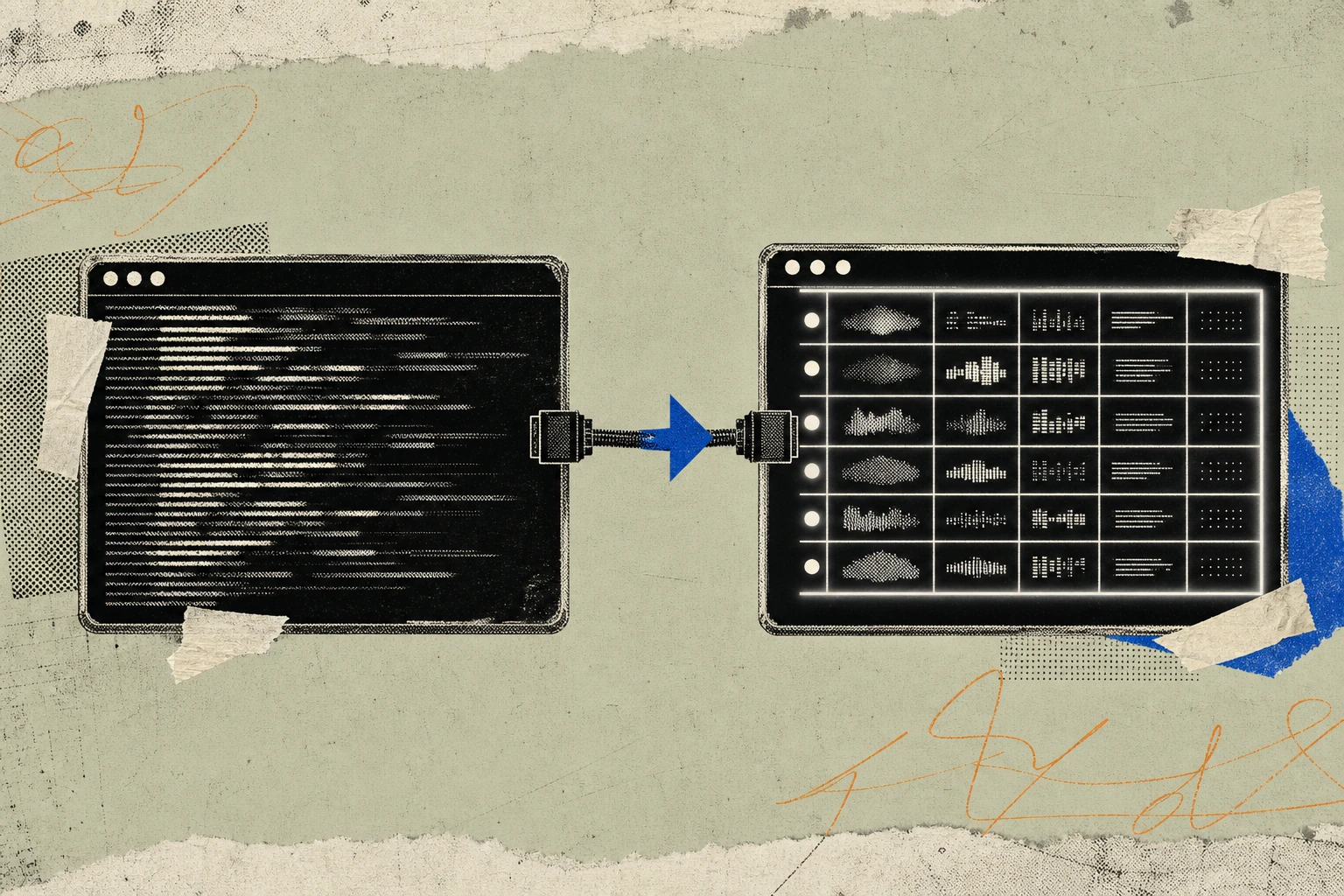
Agent workflows break that model. An agent does not read a transcript. It retrieves passages from a corpus in response to a query, ranks them, and passes the top-k into a language model as context. The retrieval step is where the semantics live, and the semantics are encoded in vectors. The quality of the answer the analyst sees at the top of the stack is bounded above by the quality of the embedding index at the middle. If the index maps "gross margin compression" and "unit economics deterioration" to distant regions of vector space, no amount of downstream model capability will recover the passages the analyst actually needed.
That structural fact is what is pulling the middle layer out. The players are converging on it from both directions. Transcript producers are moving up the stack by shipping their own embeddings, MCP endpoints, and structured feeds. General-purpose embedding vendors are moving down the stack by tuning models specifically on finance corpora and selling them as finance SKUs. Agent-facing platforms are looking at both and asking whether they should build the index themselves, license it, or acquire the transcript layer that produces it. The middle is where the compression is happening, and the middle is where the margin is going to settle.
AlphaSense and Tegus: consolidating the index
AlphaSense's June 2024 acquisition of Tegus is the clearest single move in this direction. AlphaSense has been running domain-tuned embeddings across its transcript and filings corpus for years, most visibly through Smart Synonyms, which maps queries to semantically related terms in the finance domain rather than relying on lexical match. That capability was already the differentiator against generic enterprise search. What Tegus added was corpus.
Tegus's asset was one of the largest libraries of expert-call transcripts in the market, built up over years of running its own expert network calls and preserving the transcripts under structured access. Folded into AlphaSense's retrieval stack, those transcripts become vector-indexed alongside earnings calls, filings, and broker research under a single embedding regime. The reason that matters is that expert calls and earnings calls talk about the same companies in different registers, and a retrieval system that can span both surfaces is materially more useful to a buy-side analyst than one that can only search either alone.
Our read is that the acquisition was not primarily about the expert network business as a services line. It was about the transcript corpus as a training and retrieval asset. Owning the corpus lets AlphaSense do two things at once: sell access to the transcripts directly to analysts, and use the transcripts as the substrate for the embedding index that agent-facing customers query. The corpus is the moat; the index is the product.
The finance-tuned embedding model as a standalone SKU
While the transcript layer was consolidating, the embedding-model layer was going the other way and disaggregating from any specific application. Three moves in particular are worth naming.
MongoDB's February 2025 acquisition of Voyage AI placed a well-regarded domain-tuned embedding provider inside a database company. Voyage had built a reputation on producing embedding models that outperformed general-purpose alternatives on retrieval benchmarks in specific verticals including finance. Sitting inside MongoDB, the same models now ship as part of the retrieval stack customers already use to store their vectors, which lowers the integration cost for any finance team building a RAG pipeline over its own transcript corpus.
Cohere's Embed v3, launched in late 2023 and iterated since, was explicitly positioned around retrieval quality on domain-specific corpora, with finance among the named use cases. Cohere sells the model as a standalone API, decoupled from any particular application layer, which is the shape of a product designed to be embedded into other people's stacks rather than to compete for the end analyst's attention.
OpenAI's text-embedding-3-large, released in January 2024, is not finance-specific but has become a default choice for third-party finance RAG builds because it is competitive on general benchmarks, cheap at scale, and trivially available inside any pipeline already calling OpenAI models for generation. Its ubiquity matters because it sets the reservation price against which finance-tuned embeddings must justify their premium. If a finance-domain embedding costs three times as much per million tokens, it needs to deliver retrieval improvements that flow through to answer quality in ways the analyst can feel.
The pattern across the three is the same. The embedding model has become an object that is bought, priced, and swapped independently of the transcript source it indexes and the agent that queries it. That is the definition of a distinct product category.
Aiera and the machine-readable transcript feed
Aiera has been unusually explicit about the direction the transcript itself is heading. The company has publicly described building event-tagged, speaker-attributed transcript feeds designed to be consumed by downstream models rather than read by humans. Sections are marked. Speakers are attributed with role metadata. Events (guidance changes, capital allocation announcements, M&A commentary) are tagged inline. The output is structured for retrieval, not for reading.
We read this as the transcript layer voluntarily conceding that its consumer is now upstream software, not downstream analysts. The PDF-shaped transcript, formatted for a human to page through, is a legacy artefact. The feed-shaped transcript, chunked at semantic boundaries with metadata attached, is the input a retrieval system actually wants. A transcript vendor that ships only PDFs is asking every downstream customer to redo the chunking and tagging work, which is exactly the kind of duplicated effort that gets consolidated away when a market matures.
Section tagging and event attribution also change the economics of retrieval. A query about capital allocation on a specific earnings call can be routed to the tagged capital-allocation section before the embedding search even runs, which lowers cost and improves precision. Metadata reduces the work embeddings have to do; embeddings reduce the work generation has to do. The stack composes cleanly when each layer respects the shape of the layer above it.
The downstream: agent platforms as the retrieval index's customer
Rogo, Hebbia, and Bridgetown Research all sit downstream of the embedding layer, building agent-facing research surfaces that treat the vector index as an input rather than something to be built from scratch. Their product surface is the analyst-facing query interface, the memory, the multi-step reasoning over retrieved context. The transcripts and their vector representations are commodity from their point of view, in the specific sense that they would rather license or acquire the index than maintain their own.
Rogo's 2025 acquisition of Arvo is the exception that clarifies the rule. Arvo brought a finance-tuned meeting transcription layer directly into Rogo's stack, which we read not as a bet against the middle layer but as a bet that owning the meeting-transcript slice of the corpus, the one that is genuinely proprietary to each customer, is the piece worth building rather than buying. Earnings call transcripts are widely available. Expert call transcripts are contested. Internal meeting transcripts are private to the customer and are exactly the corpus an agent-first workflow most wants to reason over. Rogo folded that layer in because it could not license it.
The generalisable point is that agent platforms are making per-corpus decisions about build versus buy, and the decision turns on whether the corpus is shared or proprietary. Shared corpora (SEC filings, earnings calls, published research) get licensed through the middle layer. Proprietary corpora (internal meetings, private notes) get built into the platform itself. Expert calls sit in the contested middle, which is why they are the most fought-over asset in the stack right now.
Where the margin settles
The economic question underneath all of this is where the retrieval margin ends up. Our read is that in a stack composed of raw transcripts at the bottom, a domain-tuned embedding index in the middle, and agent surfaces at the top, the middle captures disproportionate margin for three reasons.
First, the middle layer is where domain specificity most compounds. Raw ASR gets better across the board as foundation-model capability rises, and the accuracy gap between finance-specific and generic ASR narrows every quarter. Agent surfaces compete on UX and workflow integration, which are hard to differentiate durably. The embedding index is the layer where finance-specific training data (millions of transcripts labelled with the actual semantics analysts use) translates directly into a retrieval quality gap that is hard to close from outside the domain.
Second, the middle layer has switching costs on both sides. The transcript producer below has to re-tune to a new embedding regime if it wants to serve a new index; the agent platform above has to re-benchmark and re-index if it wants to swap providers. That two-sided lock-in is the structural signature of a category that will consolidate around a small number of winners.
Third, the middle layer is where the pricing power sits because it is the layer that determines answer quality. Agent platforms cannot promise better answers than their retrieval layer can surface. Transcript producers cannot capture the value of their corpus unless someone indexes it well. The index is the binding constraint, and the binding constraint prices at a premium.
This is why we read AlphaSense's Tegus acquisition, MongoDB's Voyage acquisition, and Rogo's Arvo acquisition as the same move, executed from three different starting points. Each is an attempt to sit at the middle layer, either by owning the corpus the index is built from, owning the model that produces the index, or owning the pipeline that feeds the index. The three vantage points do not need to converge on the same winner. They do need to converge on the same layer.
Counterargument: does the middle layer actually hold?
The honest counterargument is that foundation-model capability keeps rising and could collapse the middle layer entirely. If a general-purpose model gets good enough at long-context reasoning that agents can be given raw transcripts directly, chunked naively and embedded with a generic model, the retrieval margin evaporates and the middle disappears.
We are skeptical of this trajectory for a specific reason: cost. Long-context reasoning at high quality is expensive per query, and buy-side workflows involve running many queries against overlapping corpora. Retrieval is the mechanism by which those workflows stay economically viable at scale. Even if a foundation model could in principle reason over a raw transcript corpus at query time, the cost structure pushes toward pre-computing an index once and querying it many times. Pre-computed indexes require an embedding regime. Domain-tuned embedding regimes require a specialised producer. The middle layer is a cost story as much as a quality story, and the cost story is more durable than the quality story.
A second counterargument is that the middle layer commoditises rather than concentrates. If a handful of finance-tuned embedding models become roughly interchangeable, and MCP-style standards make the transcript feeds portable, the index becomes a utility rather than a product. That is possible, and it is the scenario in which OpenAI's text-embedding-3-large as a default would eat the specialised finance-embedding SKUs. Our read is that this outcome is likely for the general finance case (broad earnings call retrieval) but unlikely for the contested cases (expert calls, internal meetings, private notes) where the corpus itself is the moat and the embedding regime is specific to it. The utility scenario and the concentrated scenario can both be true, on different slices of the corpus.
Implications for expert networks and transcript vendors
For expert networks, the strategic question is whether the transcripts of their own calls are an asset to be monetised through the middle layer or a liability to be defended against. AlphaSense's Tegus deal makes clear that a corpus of expert-call transcripts can be worth a large acquisition price when it is the substrate for a retrieval index the acquirer already operates. That is a valuation on the corpus that did not exist when the transcripts were purely a compliance artefact.
At the same time, the more expert-call transcripts are indexed and made retrievable, the harder it becomes for expert networks to justify pricing new calls at the level they historically did, because a retrieval query over past calls substitutes for a meaningful fraction of new-call demand. That tension will not resolve cleanly. Our read is that expert networks that own the transcript indexing (or license it under favourable terms) capture some of the retrieval upside; expert networks that do not, get disintermediated by the middle layer built on top of their transcripts.
For transcript vendors more broadly, the imperative is to ship what the retrieval layer wants: embeddings, MCP endpoints, section-tagged feeds, event annotations. Shipping PDFs is shipping to the wrong customer. The customer is upstream software, and the software wants structure.
Are your experts using AI to cheat?
Try our free demo to find out today.
Powering institutional-grade transcription for expert networks.
INFLXD provides AI-powered, human-edited transcription with sub-1% error rates for the world's leading expert networks and financial research firms.
Visit inflxd.com →Keep reading.

How Expert Networks Handle Recusal When a Consultant Becomes Conflicted Mid-Engagement
The operational playbook for what happens between initial screening and the post-call score, when an expert's conflict profile changes after the project has already started.

How Expert Networks Screen for Non-Competes and Garden Leave: A Field Guide for Buy-Side Compliance
The screening layers that stand between a former-employer call and a legal problem, and how buy-side teams should read them.

How Buy-Side Firms Handle Expert-Network Call Translation for Cross-Border Research
Seven structural models buy-side teams use when the expert and the analyst do not share a working language, and the cost, compliance, and transcript tradeoffs behind each.